Born in Alaska in 1993 · 30,000+ sold · Ships across the U.S. and to Canada

SHAPE, MATERIAL, SOUND

Moose Call Horns and Tubes

A horn does one job and does it better than anything else: it takes the sound you are already making and sends it further, with a deeper, more nasal tone.

WHAT THE SHAPE DOES

Length and taper decide everything

Length and taper are what decide how a horn sounds and how far it throws. Wayne’s runs 14.5 inches, tapering from under two inches at the narrow end to seven inches at the wide end. His was the first two-stage angled design.

A rigid horn also does jobs a soft one cannot: raked against a trunk or struck on a dead spruce it thrashes; waved, it flashes like antler; turned around, it becomes a listening horn; scooped and poured, it makes the sound of a cow urinating.

This is one of the types compared on moose calls.

THIRTY-TWO YEARS

What fiberglass taught him

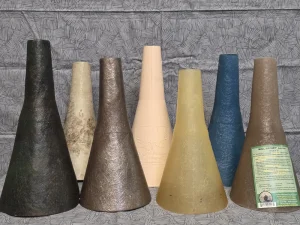
From 1993 through 2024, every one was handcrafted in Alaska from fiberglass, mostly by Wayne and Marilyn. They ran 13 to 18 inches and were mostly antler-colored light brown, with some in white and camouflage and a few in red and blue for friends who wanted to cheer on a team.

Fiberglass is genuinely durable, and it has real drawbacks. It can crack or split under extreme use. It gives off a chemical odor. It can leave you itching or picking out slivers. An accidental knock rings tinny. And how good the thrashing sounds depends far too much on how you happen to be holding it.

Fiberglass models are still available in limited quantities. Ask, if that is what you want.

Seven fiberglass Bull Magnet moose calls in different colours lined up side by side
Fiberglass Bull Magnets from across the years.

What changed in 2025

After researching resin and polymer blends, five finalists were narrowed down and six samples of each were produced. Nine of the most experienced moose hunters and guides in Alaska put them through repeated striking and abuse down to −5°F, left them out in rain and sunlight, and judged sound quality across the whole temperature range. The winner was unanimous.

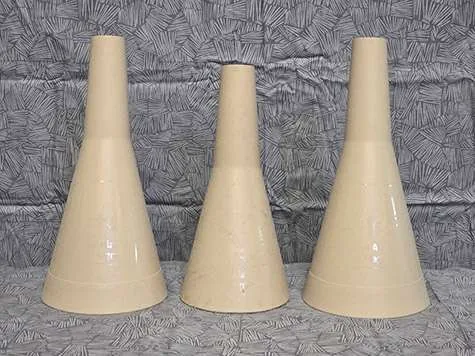
It is lighter and stronger, the tone is slightly deeper, the nasal quality is better on both cow calls and bull grunts, and one unit sounds like the next, which fiberglass never quite managed. The shape did not change at all. The new cream color shows up better when you are flashing.

ON MAKING IT SMALLER

He took a jigsaw to one

A fair question, since you carry it for days. Wayne once removed the 1.5-inch reinforced band as an experiment. It saved three ounces and changed the performance very little, but the full-size model is still what he recommends, and no smaller version is offered.

Wayne and Marilyn Kubat holding Bull Magnet moose calls in Wasilla, Alaska

Wayne Kubat, Alaska Master Guide #147. Assistant guide from 1981, registered guide since 1986, and the designer of the Bull Magnet® moose call. About Wayne

A full-size Bull Magnet beside a cut-down experimental model
The full-size model beside the cut-down experiment.

14.5 inches, 11 ounces, five jobs

Born in Alaska in 1993 and made in the USA.