
Born in Alaska in 1993 · 30,000+ sold · Ships across the U.S. and to Canada
AN HONEST COMPARISON
START HERE
Your voice is the call. Everything else on this page just carries it further or shapes the tone. Cup your hands over your mouth, pinch your nose, and you can make a cow call good enough to bring a bull in. That is the whole trick, and hunters have been doing it that way for a very long time.
Break a two-inch spruce branch and you have made a thrashing sound that works from late August onward. An axe handle works. An old shoulder blade works.
So the honest question is not which call do I need. It is what does a horn add to what I can already do. That is what the rest of this page is about.
SIDE BY SIDE
FREE
Does well: Costs nothing, weighs nothing, never breaks, always with you. Good enough to kill moose and always has been.
Falls down: Distance. Your voice alone carries up to about half a mile in timber, which is roughly as far as a bull will hear it. Through a horn the same call is projected two to three times further. It also takes practice to hold a long, wavering call for a minute without running out of air.
TRADITIONAL
Does well: The original North American moose call, rolled from bark and tied. It shapes the voice properly and it looks the part, because it is the part. Wayne’s own verdict is that they sound pretty good.
Falls down: Durability, once you actually use one. They get wet, and they wear out quickly under heavy use. Raking is what kills them fastest of all.
HORNS & TUBES
Does well: Volume and tone. A horn carries your call much further and adds the deep nasal resonance a moose is listening for. Rigid ones double as a thrashing tool. With the right wind, a long cow call through a horn reaches two miles.
Falls down: Bulk, and material. Fiberglass is durable but it can crack or split under real abuse, it gives off a chemical smell, it can leave slivers and itch, and an accidental knock gives a tinny ring.
CHECK THE RULES
Does well: Plays recorded moose sounds at volume with no skill required, which is genuinely useful for learning what the sounds are supposed to be.
Falls down: Rules on electronic and amplified calls vary by state and province, and they change. Check the current regulations for the exact unit you are hunting before you carry one. Nothing on this page should be read as saying an electronic caller is legal where you hunt. Wayne’s answer for his own state: electronic callers are not legal for hunting moose in Alaska. That is Alaska, and only Alaska. Beyond that: a recording plays the same way every time, and it cannot answer a bull that is already talking to you.
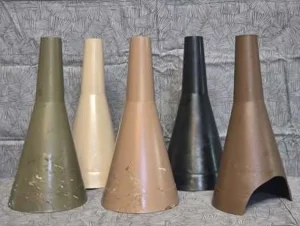
When the material changed in 2025, nine of the most experienced moose hunters and guides in Alaska tested five finalists: struck and abused down to −5°F, left out in rain and sunlight, and judged on sound across the whole temperature range. The winner was unanimous.
CHOOSING
Hunting close timber, or on a budget? Your voice and a dead spruce will do it. Learn the sounds first. That is free, and it is the part that actually matters. Hear all four sounds.
Hunting big open country, swamps and drainages, where a bull might be two miles off? You want a horn. Length and taper decide how far your call carries and how deep it sounds.
Hunting somewhere with a short season and one tag? Learn the method before you spend anything on gear. How to call a moose.
GO DEEPER

Wayne Kubat, Alaska Master Guide #147. Assistant guide from 1981, registered guide since 1986, and the designer of the Bull Magnet® moose call. About Wayne
He built his first megaphone before he sold any, and has been making them in Alaska since 1993, more than thirty thousand of them. The current one is 14.5 inches, 11 ounces, cream-colored so it works for flashing, with a textured grip and a reinforced striking end. It carries your calls, thrashes, scoops and pours water, flashes like antler, and turned around it makes a listening horn.