
Born in Alaska in 1993 · 30,000+ sold · Ships across the U.S. and to Canada
TRADITIONAL AND MODERN
They sound good. That is not the argument. The argument is what happens to one after a season of real use.
WHAT BARK GETS RIGHT
Rolled from bark and tied, the birch bark horn has been used on this continent for as long as people have hunted moose. It shapes the voice properly and it looks the part, because it is the part. It is one of five kinds compared on the moose calls hub.
Wayne’s verdict is not hedged, and it is worth reading from someone who sells the alternative:
Birch bark horns sound pretty good.
A bark horn in the hands of a hunter who knows the sounds will bring a bull in. The sound was never the problem. Everything below is about what the material does over time, not about tone.
WHERE IT GIVES OUT
They’re just not durable. They will get wet and they wear out quite fast with abuse — with a lot of use. The fastest abuse is if you do a lot of raking. They just don’t hold up.
That is the whole of it, and it is specific. Not that bark is fragile in the abstract — that the two things a moose hunt does to a call are the two things bark does not take. It gets wet, because you are out in it for days. And it gets raked, because raking brush is half of what calling a bull actually involves.
A call that only calls never meets the second problem. A call you also thrash with meets it every morning.
A hunter wrote to us in 2025 about how it is normally done there:
“Traditionally in Maine, many will carry a call and use a moose scapula to rake the brush and imitate an antler when closing the distance on a bull. I love that I have the ability to do all with one piece of equipment thanks to your product!”
A shoulder blade for the raking, a horn for the calling. That is not a criticism of either — it is a working hunter solving the problem with what works. It is also the clearest description of the gap.
SIDE BY SIDE
You supply the voice either way. The difference is how many of the other things on a moose hunt the same object can do.
Length and taper are what decide how far a horn throws and how deep it sounds, whatever it is made of. How shape and material change the sound.
WHAT HUNTERS SAY
It looks a lot more durable than the birch bark calls. I can’t wait to try it.
Dustin G., Alaska.
Both letters say the same thing from opposite directions: one hunter comparing the two in his hands before a season, one comparing them after thirty years of carrying a scapula. Neither says bark sounds wrong.
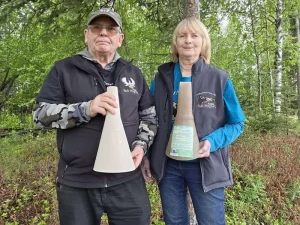
Wayne Kubat, Alaska Master Guide #147. Assistant guide from 1981, registered guide since 1986, and the designer of the Bull Magnet® moose call. About Wayne
14.5 inches, 11 ounces, made in the USA, and over 30,000 of them out with hunters since 1993.